Warranties
  Rebates
  Tax Credits
  Sustainability
  Careers
  Help
Help 


Rheem® Expands Hydronics Portfolio with New High-Performance Product Launch
June 1, 2026
 Facebook
  X
X  LinkedIn
 Rheem® is expanding its presence in the hydronics market with a powerful lineup of new products designed to deliver greater capacity, efficiency, and flexibility across residential and light commercial applications.
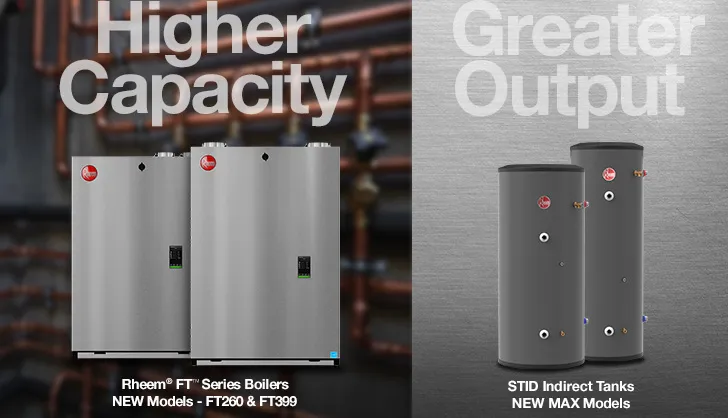
This launch represents a strategic line extension of both the Rheem® FT™ Series boilers and Rheem Indirect tanks, introducing higher-capacity solutions tailored for “large residential” and “light commercial” needs. It reinforces Rheem’s ongoing commitment to growing in the hydronic space and delivering solutions for a broader range of applications.
Rheem FT Series Expansion: Higher BTU, Greater Flexibility
Rheem is extending the trusted FT Series with two larger-capacity models:
- FT260 (260k BTU)
- FT399 (399k BTU)
These additions bring expanded performance capabilities to projects that require more output, while maintaining the efficiency and control contractors expect.
Key Features:
- Up to 96% Thermal Efficiency (FT399) and 95% AFUE (FT260)
- 10:1 Turndown Ratio for optimized energy savings
- Cascade Capability — control up to 24 boilers
- BACnet Interface Option for advanced system integration
With these higher BTU options, the FT Series now supports a wider range of system designs, from large homes to light commercial installations.
Spec sheet and Brochure are available for more information.
Indirect Tank Line Extension: MAX Performance Models
Rheem is also growing its Indirect Tank portfolio with new MAX models, designed to deliver higher domestic hot water output for demanding applications.
New Models:
- STID80-MAX (80 Gallon)
- STID119-MAX (119 Gallon)
What Sets MAX Models Apart:
- Higher output vs. standard models
- Longer coil design for improved heat transfer
- Greater BTU transfer capability
These upgrades translate into faster recovery and higher hot water availability—ideal for larger homes and light commercial environments.
Spec sheet and Brochure are available for more information.
Coming Soon: New STB Series Buffer Tanks: Optimized System Performance
Completing the launch is the introduction of the Rheem® STB Series Buffer Tank Water Heaters—a high-performance solution designed to enhance hydronic system efficiency when paired with condensing boilers or air-to-water heat pumps.
New Models:
- STB25 (25 Gallon)
- STB55 (55 Gallon)
- STB80 (80 Gallon)
Engineered for Performance & Reliability
The STB Series is built to improve system operation, stability, and longevity across a wide range of applications.
Key Features:
- Reduces short cycling by increasing system water volume
- Improves system stability under varying load conditions
- Supports high-efficiency systems with condensing boilers and air-to-water heat pumps
- Stainless steel tank construction for durability and corrosion resistance
- Stainless steel connection fittings for long-term reliability
- Flexible piping configuration with multiple 1½” NPT connections
- Optimized connection layout with top system supply and side return
- Side heating connections for easier installation and retrofit applications
- Integrated thermal well (3/8″ ID) for temperature sensing and control integration
- 2″ polystyrene foam insulation to reduce standby heat loss
- Durable polypropylene jacket to resist scratches and dents
These buffer tanks help stabilize system performance, reduce wear on equipment, and ensure consistent comfort—especially in systems with variable demand.
Spec sheet and Brochure are available for more information.
Built for a Broader Range of Applications
This product expansion highlights Rheem’s continued investment in hydronics. By adding higher BTU FT Series boilers, larger-capacity indirect tanks, and high-performance buffer tanks, Rheem is delivering solutions for:
- Larger residential homes
- Multi-zone systems
- Light commercial applications
- High-demand domestic hot water systems
This launch reinforces that Rheem is serious about being a leader in hydronic space, offering scalable, efficient solutions designed for today’s evolving system requirements.